
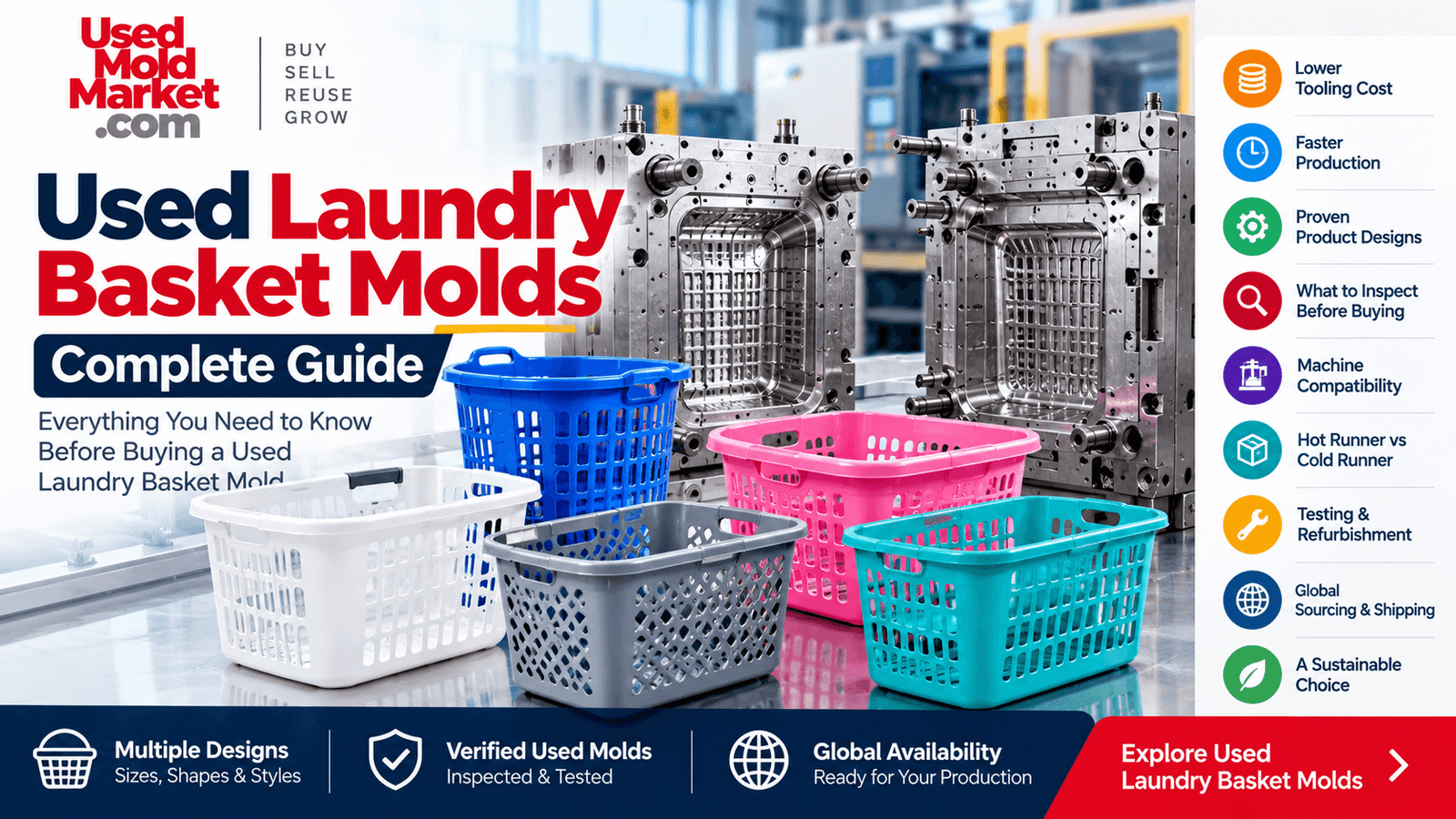
The laundry basket is a widely used household plastic product with applications ranging from homes and laundromats to hotels, hostels, retailers and commercial facilities. For plastic manufacturers, laundry baskets can be an attractive product category because different sizes, shapes, colors and designs can be developed for different markets.
However, manufacturing a competitive laundry basket requires the right injection mold. For manufacturers looking to reduce tooling investment, a used laundry basket mold can be a practical alternative to commissioning a completely new mold.
The important question is not simply whether a used mold is cheaper. It is whether the mold is technically suitable, structurally sound and capable of producing consistent parts.
This guide explains what manufacturers should know before buying a used laundry basket injection mold, what to inspect, and how UsedMoldMarket.com can help.
What Is a Laundry Basket Injection Mold?
A laundry basket injection mold is a precision tool used to manufacture plastic laundry baskets through the injection molding process.
Laundry baskets can vary considerably in design. Depending on the target market, they may feature:
Because laundry baskets are relatively large household products, mold design, cooling, ejection and machine compatibility are particularly important.
A manufacturer should therefore evaluate the complete mold system, rather than focusing only on the appearance of the cavity.
Why Consider a Used Laundry Basket Mold?
Manufacturing a new large plastic injection mold can require considerable investment, especially when the mold involves complex geometry, large dimensions, multiple cavities or special surface finishes.
A suitable used injection mold for laundry baskets can provide several potential advantages.
Lower Tooling Investment
Used molds can cost substantially less than new molds, depending on their condition, design, steel and production history.
Faster Access to Tooling
An existing mold may allow a manufacturer to move toward production faster than starting the complete design and manufacturing process for a new mold.
Proven Product Design
Where production history and sample parts are available, buyers can evaluate a design that has already been used in production.
Product-Line Expansion
A manufacturer already producing household products can use suitable used laundry basket molds to expand its product portfolio without investing in completely new tooling.
UsedMoldMarket.com specifically highlights lower tooling costs, reduced lead times and reuse of existing tooling as benefits of buying used molds. Used Mold Market
What Should You Check Before Buying a Used Laundry Basket Mold?
Buying a second-hand injection mold requires more than checking photographs.
Here are the most important areas to evaluate.
1. Check the Laundry Basket Design
First, make sure the existing mold produces a product that matches your market requirements.
Consider:
A good mold with the wrong product design may not provide any commercial advantage.
2. Check the Mold Dimensions
Large laundry basket molds can be substantial pieces of tooling.
Before purchasing, confirm:
Most importantly, determine whether the mold will fit your injection molding machine.
Check:
A technically excellent used mold is of little value if it cannot run efficiently on your available machine.
3. Check the Number of Cavities
Laundry basket molds can be single-cavity or multi-cavity depending on the design and production requirements.
A multi-cavity mold can increase production output, but it can also increase:
If purchasing a used multi-cavity laundry basket mold, verify that each cavity produces acceptable parts.
Don't assume that all cavities have the same condition simply because they are part of the same mold.
4. Inspect the Mold Steel
Mold steel is an important consideration when purchasing used tooling.
Common mold steels can include:
However, steel grade alone does not tell you how much useful life remains in a used mold.
You should also investigate:
A well-maintained mold with significant production history may be a better purchase than a poorly maintained mold with a seemingly attractive specification.
5. Inspect the Cavity and Core
The cavity and core create the actual laundry basket.
Carefully inspect the molding surfaces for:
For laundry baskets with textured surfaces or decorative patterns, check that the texture is still properly defined.
Wear in the molding surface can affect both the appearance and dimensions of the finished product.
6. Check the Parting Line
The parting line is particularly important for large injection-molded household products.
Check for:
A poor parting line can result in unwanted flash around the basket and may require additional mold repair.
7. Inspect the Cooling System
Cooling is one of the most important factors affecting injection molding cycle time and product quality.
A laundry basket has a relatively large molding surface, so efficient cooling is important for achieving consistent production.
Check:
Poor cooling can contribute to:
For a used mold, it is therefore important to evaluate cooling-channel condition rather than simply assuming that the channels are functional.
8. Examine the Ejection System
A large laundry basket must be released from the mold reliably after molding.
Inspect:
Watch for signs of:
An unreliable ejection system can lead to damaged baskets, cycle interruptions and increased downtime.
9. Check the Runner and Gating System
Determine whether the mold uses a hot runner or cold runner system.
Cold Runner
A cold runner system is generally simpler and may be easier to maintain, although runner scrap may be generated depending on the design.
Hot Runner
A hot runner can reduce runner waste and may provide production advantages, but the additional components need to be carefully checked on a used mold.
For a used hot runner laundry basket mold, inspect:
10. Check the Product Weight and Material
Before buying a used laundry basket mold, determine the intended product weight and plastic material.
Many household plastic products are manufactured using materials such as polypropylene, depending on the required characteristics and product design.
Ask:
Changing the material or product weight significantly from the original production setup may require process optimization or tooling modifications.
11. Request Production Samples
One of the best ways to evaluate a used laundry basket mold is to examine an actual molded sample.
Check:
Product Dimensions
Are the dimensions within your required tolerances?
Surface Finish
Is the texture or finish consistent?
Warpage
Does the basket remain dimensionally stable?
Flash
Is there excessive flash around the parting line?
Ejection Marks
Are there visible marks caused by the ejection system?
Handle Strength
If the basket has integrated handles, check their strength and appearance.
Base Stability
Place the basket on a flat surface and check whether it sits correctly.
A sample part can reveal problems that are not obvious from photographs of the mold.
12. Ask for a Mold Trial
If you are making a significant investment, a mold trial can provide additional confidence.
A trial can help evaluate:
This is particularly valuable when buying a used mold internationally.
UsedMoldMarket.com states that its molds are inspected and may be tested and refurbished where required, with condition reports, test photos and other technical information available where applicable. Used Mold Market
Used Laundry Basket Molds Available Online
UsedMoldMarket.com currently lists laundry basket molds within its Bath & Laundry product category. The marketplace currently shows a laundry basket mold as one of its available/new listings, alongside other household and plastic product tooling. Used Mold Market
The marketplace has also previously listed multiple laundry basket molds that are now marked as sold, demonstrating demand for this category of used tooling. Used Mold Market
Availability changes as molds are sold and new inventory is added, so manufacturers looking for a specific laundry basket mold should check the marketplace regularly or request custom sourcing.
How UsedMoldMarket.com Helps With Used Laundry Basket Molds
Finding a used laundry basket mold is only the first step. The bigger challenge is determining whether the mold is worth buying and suitable for your production requirements.
This is where a specialized used mold marketplace can add value.
1. Product-Specific Mold Search
UsedMoldMarket.com organizes its inventory into product categories, including Bath & Laundry → Laundry Baskets. Used Mold Market
This makes it easier for manufacturers to search specifically for the tooling required for their product rather than searching through a general used machinery marketplace.
2. Technical Mold Information
UsedMoldMarket.com listings can include information such as:
The level of information varies by listing, but the platform states that listings can include mold size and weight, cavity details, runner type, steel type, part weight, machine tonnage requirements and test photos where available. Used Mold Market
This allows buyers to make a more informed initial assessment.
3. Mold Inspection
UsedMoldMarket.com says its molds are verified and inspected by experienced tool rooms and mold-refurbishing experts. Used Mold Market
This is important when buying a second-hand injection mold because visible appearance alone cannot determine the condition of internal components.
4. Testing and Refurbishment
Where required, molds can be tested and refurbished before being supplied.
Refurbishment may involve:
The objective is to make suitable tooling production-ready, rather than simply reselling an old mold.
5. Trial Videos and Samples
For applicable molds, UsedMoldMarket.com states that it can provide trial videos and courier samples. This can be especially useful for international buyers who cannot physically visit the mold location. Used Mold Market
Seeing an actual sample produced by the tooling gives a buyer much more information than photographs alone.
6. Custom Mold Sourcing
What if the exact laundry basket mold you need isn't listed?
UsedMoldMarket.com offers custom used mold sourcing, working with mold manufacturers, refurbishers and mold traders to match tooling to a buyer's requirements. Used Mold Market
You can provide requirements such as:
 Industrial Product
 Storage Products
 Kitchenware
 Bath & Laundry
 Cleaning Product
 Baby Products
 Furniture
 Gardenware
