
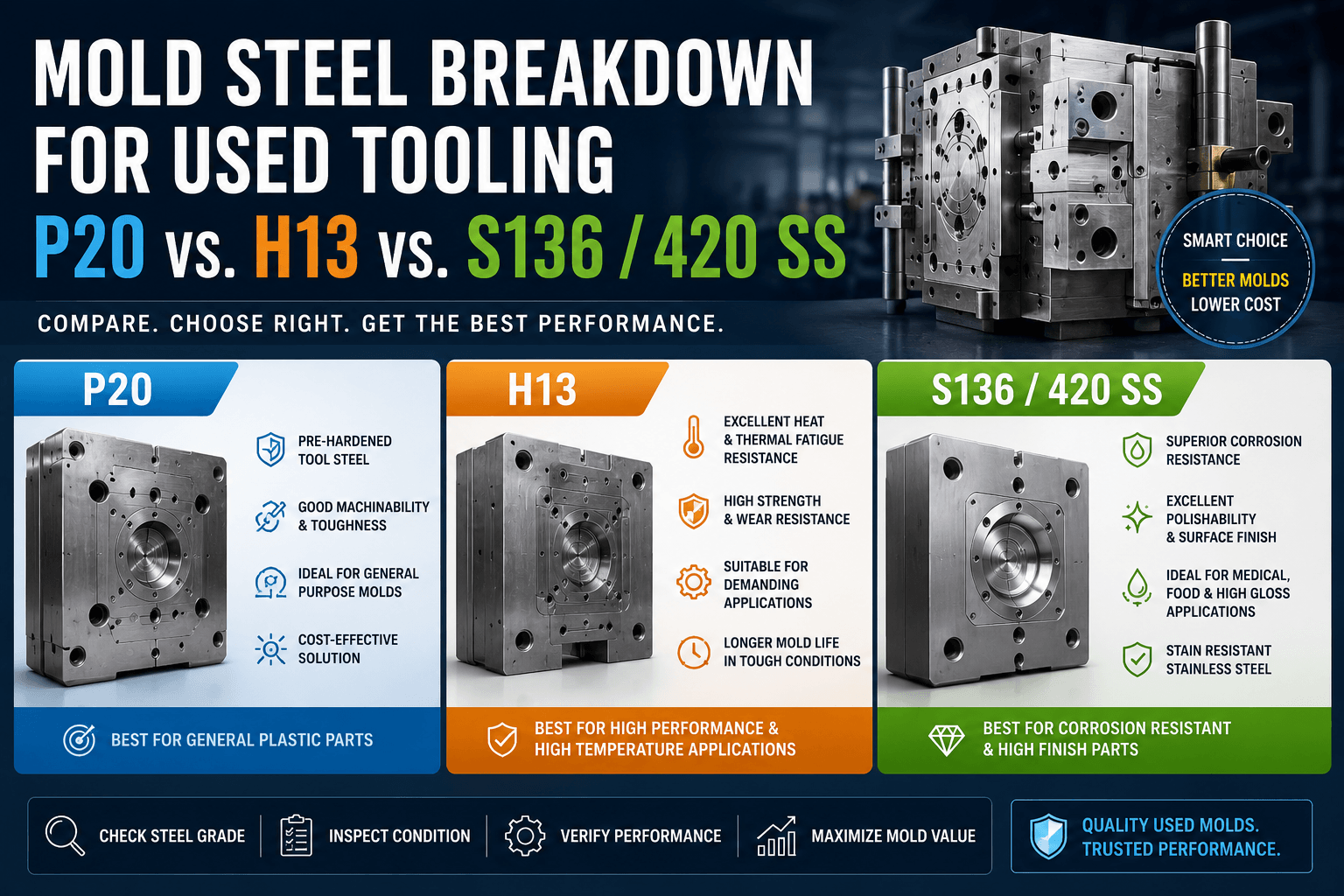
Buying a used injection mold and wondering whether P20, H13, or S136 / 420 stainless steel is the right choice? The type of steel used in an injection mold has a major impact on its durability, wear resistance, corrosion resistance, polishability, maintenance requirements, and remaining production life.
When purchasing pre-owned injection molds, understanding the difference between P20 vs. H13 vs. S136 / 420 SS mold steel is essential. A mold made from the right steel can provide years of reliable production, while a poorly maintained or unsuitable steel grade can result in excessive wear, corrosion, flash, surface defects, and costly refurbishment.
In this guide, we compare P20, H13, and S136 / 420 stainless steel for injection molding, explain where each steel is commonly used, and show you what to check when evaluating the condition of a used injection mold before purchase.
Whether you are looking for a used plastic injection mold, pre-owned injection tooling, second-hand mold, or affordable production tooling, this guide will help you understand mold steel and make a more informed buying decision.
Why Mold Steel Matters When Buying Used Tooling
A used mold's remaining value is not determined simply by its age or number of previous production cycles. The type and condition of the mold steel can be equally important.
For example, a well-maintained P20 mold may continue to provide excellent service for a general-purpose application, while an H13 mold may be preferable for demanding applications involving high temperatures or abrasive materials. Stainless mold steels such as S136 or 420 SS can be particularly valuable when corrosion resistance and high-quality surface finishes are important.
When evaluating a pre-owned mold, buyers should consider:
The right steel grade can make a significant difference to the remaining production life of a used mold.
P20 Mold Steel
P20 is one of the most widely used mold steels for general-purpose plastic injection molds. It is typically supplied as a pre-hardened tool steel, making it relatively easy to machine and suitable for many conventional injection molding applications.
P20 is often selected for molds producing consumer products, industrial components, housings, containers, and other parts where extreme wear or corrosion resistance is not the primary requirement.
Advantages of P20
Limitations of P20
Compared with higher-performance tool steels, P20 generally has lower resistance to severe wear and corrosion.
If a P20 mold has been used extensively with abrasive or corrosive materials, the cavity and core surfaces should be inspected carefully before purchase.
When Is a Used P20 Mold a Good Choice?
A pre-owned P20 mold can be an attractive option when:
For many manufacturers, a good-condition used P20 mold can offer an excellent cost-to-performance ratio.
H13 Mold Steel
H13 is a chromium-molybdenum hot-work tool steel known for its toughness, thermal-fatigue resistance, and ability to withstand demanding temperature conditions.
It is commonly associated with applications where the tooling experiences greater thermal and mechanical stresses.
H13 can be particularly useful for molds subjected to repeated heating and cooling cycles and demanding production environments.
Advantages of H13
Limitations of H13
H13 tooling can be more expensive to manufacture and may require more careful machining and finishing than a conventional P20 mold.
For used H13 tooling, the buyer should also evaluate the steel's actual condition rather than assuming that the steel grade alone guarantees long remaining life.
What to Check on a Used H13 Mold
When inspecting pre-owned H13 tooling, pay particular attention to:
A properly maintained H13 mold can be an excellent choice for demanding applications.
S136 / 420 Stainless Mold Steel
S136 is a stainless mold steel commonly used where corrosion resistance, polishability, and good surface quality are important. It is often associated with applications such as medical components, optical parts, food-related products, and other applications where mold corrosion and surface finish are significant concerns.
S136 is closely associated with the 420 stainless steel family, although exact grades, compositions, heat treatment, and specifications can vary by steel manufacturer and standard.
Advantages of S136 / 420 Stainless Steel
Limitations
Stainless mold steels can be more expensive than standard mold steels, and their machining and heat-treatment requirements need to be considered.
For used stainless-steel tooling, surface condition remains critical. A stainless mold should still be inspected for scratches, pitting, wear, damage, and previous repairs.
P20 vs. H13 vs. S136 / 420 SS: At a Glance
|
Feature |
P20 |
H13 |
S136 / 420 SS |
|
General-purpose tooling |
Excellent |
Excellent |
Good |
|
Toughness |
Good |
Excellent |
Good |
|
Wear resistance |
Good |
Very good |
Good–very good |
|
Corrosion resistance |
Moderate |
Moderate |
Excellent |
|
Polishability |
Good |
Very good |
Excellent |
|
High-temperature performance |
Moderate |
Excellent |
Good |
|
Ease of machining |
Good |
Moderate |
Moderate |
|
Typical positioning |
General-purpose molds |
Demanding tooling |
Corrosion-sensitive / high-finish applications |
Actual performance depends on the specific steel grade, heat treatment, hardness, mold design, processing conditions, and maintenance history.
Which Mold Steel Is Best for Used Injection Molds?
There is no single "best" mold steel for every application.
The right choice depends on the plastic material, production volume, part requirements, surface finish, operating conditions, and expected mold life.
Choose P20 when:
You need a cost-effective mold for a conventional application and do not require exceptional corrosion or wear resistance.
Choose H13 when:
The mold will experience demanding thermal and mechanical conditions and durability is a major consideration.
Choose S136 / 420 SS when:
Corrosion resistance, polishability, appearance, or demanding surface-finish requirements are important.
The important point when purchasing a used mold is that steel grade should be evaluated together with actual mold condition.
A heavily worn H13 mold may be a worse investment than a well-maintained P20 mold. Likewise, a good-condition stainless mold may command a premium because of its corrosion-resistant properties and suitability for specific applications.
How to Verify the Steel Grade of a Used Mold
Don't rely solely on the seller's description.
When purchasing pre-owned tooling, try to verify the steel grade through available documentation such as:
Where appropriate, material identification testing can also be considered for valuable tooling.
However, identifying the steel grade is only one part of the inspection.
The mold should also be evaluated for its current physical condition and production performance.
Inspect the Mold Condition, Not Just the Steel Grade
Two molds manufactured from the same steel can have completely different values depending on how they have been used and maintained.
For a used injection mold, inspect:
Cavity & Core
Look for scratches, corrosion, pitting, wear, polishing damage, and dimensional changes.
Parting Line
Check for dents, wear, mismatch, and areas that could cause flash.
Shut-Offs
Inspect slides, lifters, inserts, and shut-off surfaces for wear.
Cooling Channels
Check for blockage, corrosion, leakage, and restricted flow.
Ejection System
Verify that ejector pins, plates, return mechanisms, and other components operate correctly.
Mold Base
Check guide pillars, bushes, plates, screws, clamps, and signs of previous modifications.
Surface Finish
For cosmetic components, carefully examine polished, textured, or high-gloss surfaces.
UsedMoldMarket.com Mold Testing & Trials
At UsedMoldMarket.com, we understand that the steel grade is only one part of determining the value of a pre-owned injection mold. Wherever applicable, we undertake mold inspections, testing, and trials to help verify the actual working condition of the tooling. Our evaluation can include checking the cavity and core condition, parting lines, cooling circuits, mold movement, ejection system, and overall molding performance. Where trial facilities are available, test shots and molded samples can provide valuable information about the mold's ability to produce acceptable parts. This process helps identify potential issues before purchase and gives buyers greater confidence when selecting quality used injection molds from UsedMoldMarket.com.
What Should You Ask Before Buying a Used Mold?
Before purchasing pre-owned tooling, ask the seller or supplier:
The answers can help you determine whether the mold is ready for production or requires refurbishment.
Conclusion: Choose the Steel and Condition That Match Your Application
When purchasing a pre-owned injection mold, understanding mold steel is essential.
P20 offers a strong combination of machinability, toughness, and value for general-purpose tooling. H13 is well suited to more demanding thermal and mechanical applications. S136 / 420 stainless steel provides an important advantage where corrosion resistance and high-quality surface finishes are required.
But the steel grade is only the starting point.
The actual condition of the mold, its maintenance history, cooling performance, parting-line condition, cavity and core wear, and trial results should all be considered before making a purchase.
A properly inspected used mold can provide significant savings compared with manufacturing a new tool from scratch—while still delivering reliable production performance.
Looking for quality pre-owned injection molds? Explore available tooling at UsedMoldMarket.com and make your next mold investment with greater confidence.
 Industrial Product
  Storage Products
  Kitchenware
  Bath & Laundry
  Cleaning Product
  Baby Products
  Furniture
  Gardenware
  Ready Molds