
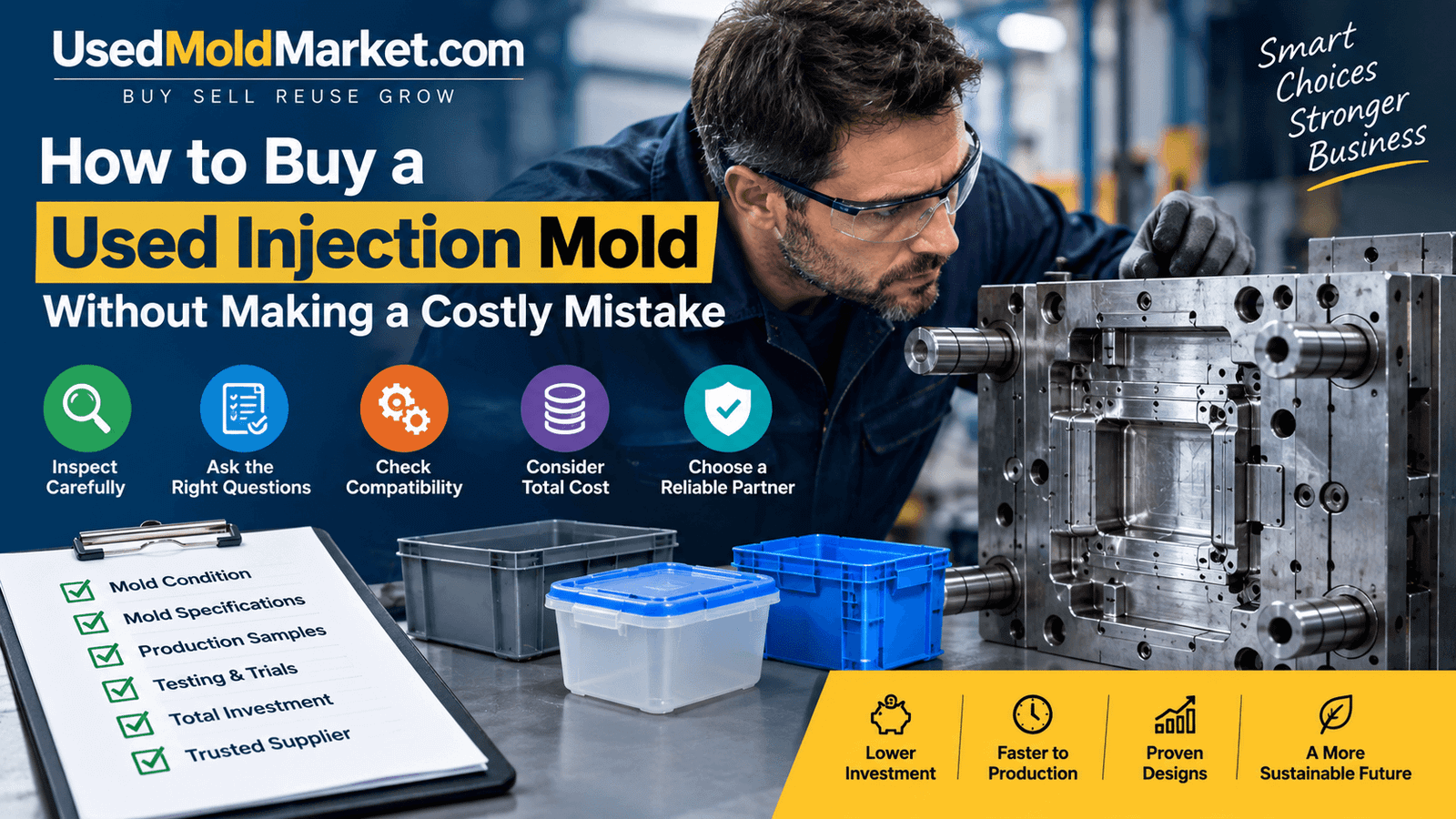
Buying a used injection mold can be an excellent way to reduce tooling costs, shorten lead times and bring a plastic product into production faster. But buying used tooling is not as simple as finding a mold at the lowest price.
A mold may look attractive in photographs and still have worn cavities, damaged cooling channels, excessive cycle history, ejection problems or other issues that can turn a seemingly inexpensive purchase into an expensive repair project.
The key is to evaluate the complete value and condition of the mold, not just its asking price.
In this guide, we explain how to buy a used injection mold, what to inspect before purchasing, which questions to ask the seller, and how UsedMoldMarket.com helps manufacturers source and evaluate used molds with greater confidence.
A new injection mold can involve significant tooling costs and manufacturing lead times, particularly for large, multi-cavity or technically complex molds.
A used plastic injection mold can provide an alternative when an existing tool matches your product requirements.
Potential benefits include:
UsedMoldMarket.com specifically positions used molds as a way to reduce tooling costs and avoid some of the lead time associated with manufacturing new tooling.
However, cheap does not always mean good value. The condition and suitability of the mold are what ultimately determine whether the purchase makes financial sense.
One of the most common mistakes when buying a second-hand injection mold is searching for a cheap mold first and trying to make a product around it.
Instead, start by defining your production requirements.
Determine:
Once these requirements are established, you can determine whether an available used injection mold for sale is actually suitable.
A mold that produces the right product is not necessarily compatible with your injection molding machine.
Before purchasing, verify:
Also check whether the mold can physically fit between the machine's tie bars and whether the injection unit can properly interface with the mold.
UsedMoldMarket.com listings can include technical information such as mold size, weight, cavity details, runner type, steel type, part weight and machine tonnage requirements, helping buyers evaluate machine compatibility before making a decision.
Never assume that a mold will fit your machine simply because another manufacturer used it successfully.
Your machine specifications may be different.
The number of cavities has a direct effect on production output.
For example:
But more cavities don't automatically mean a better mold.
A multi-cavity mold may require:
When buying a used multi-cavity injection mold, make sure all cavities are capable of producing acceptable parts.
The mold steel is another important factor when evaluating used tooling.
Common injection mold steels include:
However, don't make the mistake of thinking that a particular steel grade automatically means the mold is in good condition.
Two molds made from the same steel can have completely different remaining service lives.
You should also evaluate:
Steel grade + actual condition + production history provide a much better picture of a mold's value.
The cavity and core are among the most important components of an injection mold.
Look carefully for:
Excessive wear can affect product dimensions and surface quality.
Corrosion can be particularly problematic in molds that have been stored improperly or exposed to moisture.
Deep scratches or damaged molding surfaces may transfer defects to the finished product.
Ask whether cavity or core surfaces have previously been welded or modified.
A damaged parting line can result in excessive flash and may require significant repair.
If possible, request detailed photographs of the molding surfaces rather than relying only on general photographs of the closed mold.
Cooling is critical to injection molding performance.
The cooling system influences:
A used mold may have cooling channels that are partially blocked, corroded or contaminated.
Ask for information about:
A mold with poor cooling performance can increase production costs even if the initial purchase price is attractive.
The mold must release the finished part reliably.
Inspect components such as:
Look for signs of:
An ejection problem can result in cycle interruptions, damaged parts and increased downtime.
Determine whether the mold uses a:
Generally simpler and easier to maintain, but it may produce runner scrap depending on the design.
Can reduce runner waste and may improve production efficiency, but the system contains additional components that need to be inspected.
For a used hot runner mold, inspect:
A hot runner mold should not be evaluated solely on the condition of its steel plates and cavities.
A mold's history can tell you a lot about its remaining value.
Ask:
How old is the mold?
How many cycles has it completed?
What material was previously molded?
What product was produced?
Where was it previously used?
When was it last in production?
What maintenance has been carried out?
Which components have been replaced?
Has the mold been modified?
Has it undergone major repairs?
The answers can help you distinguish between a lightly used mold and a heavily worn production tool.
This is one of the most valuable steps in evaluating a used injection mold.
Inspect the samples for:
For products with lids, hinges, clips or snap-fit features, check that those mechanisms work correctly.
A sample part can reveal problems that photographs of the mold cannot.
If there is significant uncertainty about the mold's condition, a trial can be extremely valuable.
A mold trial can help evaluate:
UsedMoldMarket.com states that molds go through inspection and, where required, testing and refurbishment to ensure production readiness; its FAQ also notes that trials and sampling can take around 15–30 days, depending on the process.
For a high-value mold, the cost of proper testing can be small compared with the cost of discovering a major problem after the mold has been shipped to your factory.
A used mold may require some refurbishment before production.
Potential refurbishment work can include:
The important question is not simply:
"Is this mold used?"
The better question is:
"What condition is this mold in today, and what work is required before production?"
This is where many buyers make their biggest mistake.
Suppose a used mold is offered at a very attractive price.
But after purchase you discover that it requires:
The actual cost could be significantly higher.
Before buying, calculate:
Total Mold Investment = Purchase Price + Refurbishment + Testing + Shipping + Import Costs + Modifications
Compare that number with the cost of manufacturing a new mold.
The cheapest mold is not necessarily the cheapest solution.
Injection molds are heavy precision tools and need proper packaging.
Ask about:
UsedMoldMarket.com says it supports international logistics and has shipped molds to more than 30 countries, with packaging and documentation handled as part of its logistics support.
Some used mold sellers may provide limited information or sell tooling strictly in its existing condition.
This can be acceptable for an experienced buyer with its own tool room and inspection capability.
But if you don't have the technical resources to evaluate the mold yourself, buying purely on photographs and price increases your risk.
Look for sellers or marketplaces that provide:
Choosing a reliable source can make a significant difference when purchasing second-hand injection molding tools.
UsedMoldMarket.com is a global B2B marketplace focused specifically on buying and selling used plastic injection molds. The platform connects manufacturers, molders, OEMs and tooling professionals with used molds from suppliers around the world.
Instead of searching through general industrial marketplaces, buyers can browse used molds according to product categories such as:
This makes it easier to find tooling relevant to a particular product.
Listings can provide important information such as:
This helps buyers evaluate whether a mold is technically suitable before proceeding.
UsedMoldMarket.com says its listed molds are inspected by experienced tool rooms and mold-refurbishing experts. Molds may also be tested and refurbished when required.
This is particularly valuable because used mold buying is ultimately about reducing uncertainty.
Where required, mold testing and sampling can help establish whether the tooling is capable of producing acceptable parts before it reaches the buyer's production floor.
This can help reduce the risk of discovering major tooling issues only after international shipment.
Some molds may require refurbishment before they are production-ready. UsedMoldMarket.com offers refurbished tooling as part of its offering and says molds can be refurbished when needed.
If the exact mold you need isn't currently listed, UsedMoldMarket.com also offers custom mold sourcing, working with mold manufacturers, refurbishers and mold traders to find tooling matching the buyer's requirements.
For manufacturers buying molds internationally, logistics can be as important as the mold itself.
UsedMoldMarket.com supports worldwide shipping and states that it has successfully supplied molds to more than 30 countries.
Before purchasing, make sure you can answer yes or have satisfactory information for the following:
| Check | What to Verify |
|---|---|
| Product | Does the mold produce the product you need? |
| Dimensions | Will it fit your machine? |
| Cavities | Are all cavities usable? |
| Steel | What steel is used? |
| Cavity/Core | Is there excessive wear or corrosion? |
| Parting line | Is it in good condition? |
| Cooling | Are cooling channels functional? |
| Ejection | Does the ejection system work correctly? |
| Runner | Hot or cold? What condition? |
| History | Is production/maintenance history available? |
| Samples | Are production samples available? |
| Trial | Has the mold been tested? |
| Refurbishment | What work has been carried out? |
| Machine | Is your machine compatible? |
| Shipping | Are packaging and logistics included? |
| Total Cost | What is the complete investment? |
Low purchase price can hide high refurbishment costs.
A mold that cannot run properly on your machine is not a bargain.
Internal wear may not be visible from external photographs.
Poor cooling can affect cycle time and part quality.
A sample part provides valuable information about actual mold performance.
Welding and modifications can affect mold performance and future maintenance.
International shipping of heavy molds can significantly affect the final landed cost.
A used injection mold can be a smart investment when it is properly evaluated. It can reduce tooling costs, shorten development time and provide manufacturers with an opportunity to start or expand production without commissioning an entirely new mold.
But the objective should never be to find simply the cheapest used injection mold.
The objective is to find a technically suitable, properly inspected and production-ready mold at the right total cost.
That is where careful inspection, technical documentation, mold testing and experienced sourcing support become important.
With its focus on verified used tooling, technical specifications, inspection, testing, refurbishment, global sourcing and logistics, UsedMoldMarket.com helps manufacturers make more informed decisions when buying used injection molds.
 Industrial Product
  Storage Products
  Kitchenware
  Bath & Laundry
  Cleaning Product
  Baby Products
  Furniture
  Gardenware
  Ready Molds