
In plastic manufacturing, tooling is the single largest upfront barrier to market entry. When launching a standard consumer product, an industrial container, or packaging components, manufacturers face a pivotal CapEx decision: commission a brand-new custom injection mold or acquire a proven, pre-owned mold from the secondary market?
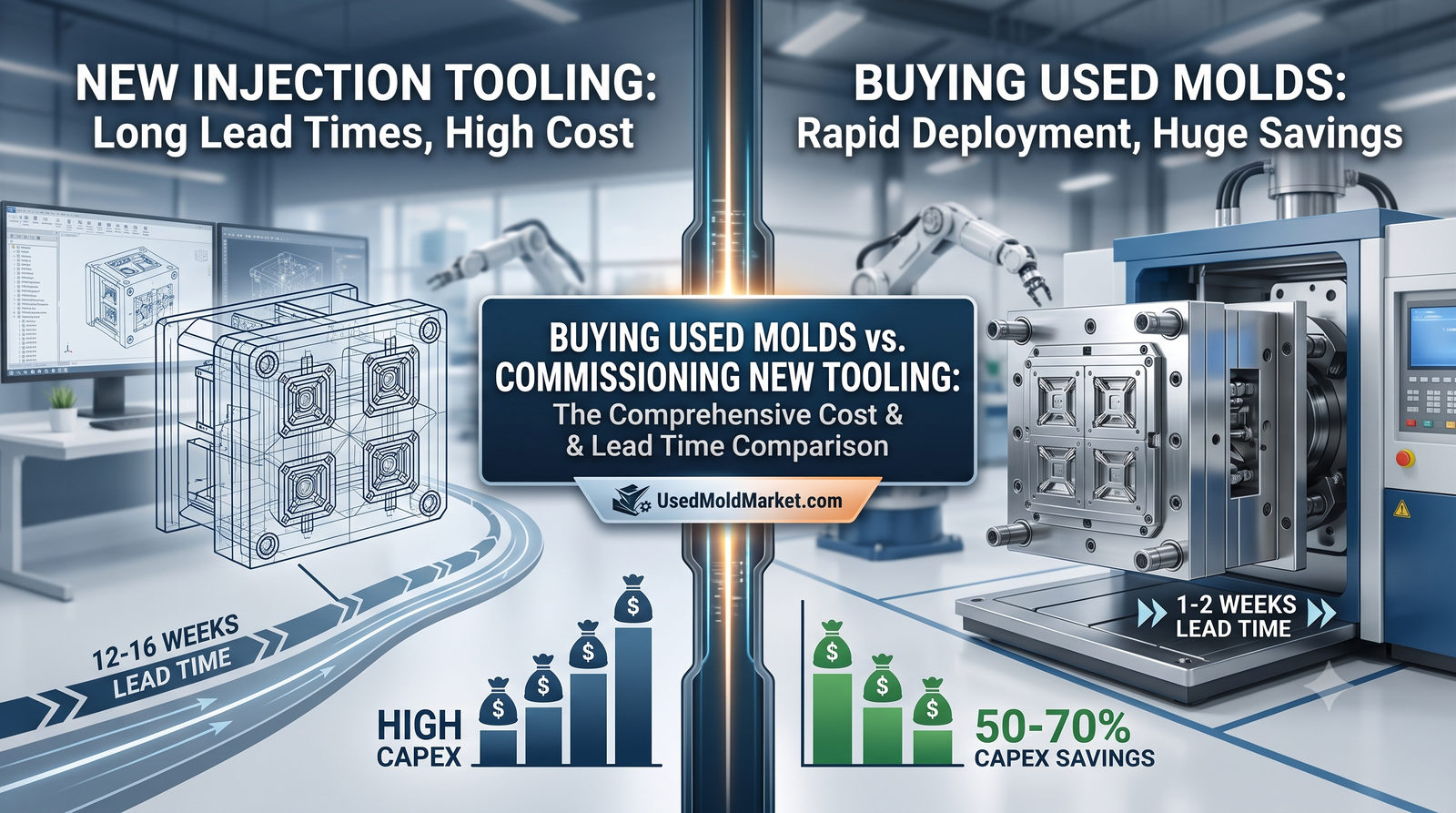
New mold builds demand substantial upfront capital, lengthy design-for-manufacturing (DFM) reviews, and multi-month machining cycles. Conversely, strategically sourcing used plastic injection molds slashes lead times from 12–16 weeks down to just 1–2 weeks while reducing tooling capital expenditure (CapEx) by 50% to 70%.
| Decision Factor | Commissioning New Tooling | Buying Pre-Owned / Used Tooling | Impact on Operations |
| Average Lead Time | 12 to 16+ Weeks | 1 to 2 Weeks | 85%+ faster time-to-market |
| Tooling CapEx Cost | $25,000 – $120,000+ | $7,500 – $40,000 | 50% to 70% CapEx reduction |
| Design & Validation | CAD, Moldflow, T1/T2 sampling | Verified production tool & past shot history | Minimal risk of core geometry flaws |
| Modification Flexibility | Built to exact custom spec | Requires cavity/insert touch-up or EDM rework | Best for standard or modular part designs |
| Shot Life Expectancy | Full life (500k – 1M+ shots) | 60% to 90% remaining shot life | High ROI for low-to-medium and standard runs |
Commissioning a new production mold involves sequential bottlenecks:
New Tooling Timeline (12–16 Weeks):
[ DFM & Moldflow (2 Wks) ] ➔ [ Steel Sourcing & CNC/EDM (6–8 Wks) ] ➔ [ Fitting & Assembly (2 Wks) ] ➔ [ T1 Samples & Tuning (3–4 Wks) ]

Used Tooling Timeline (1–2 Weeks):
[ Dimensional Inspection (2–3 Days) ] ➔ [ Logistics & Press Setup (4–7 Days) ] ➔ Production Ready
Eliminating Toolroom Queues: High-precision CNC milling, wire EDM, and heat-treatment cycles at toolrooms often face backlogs. A used mold bypasses the fabrication queue entirely.
Capitalizing on Market Windows: When demand spikes for standard crates, storage bins, preforms, or caps, waiting four months for new tooling means missing the revenue cycle. A used mold enables trial runs and full-scale production within days.
Tooling amortization directly dictates unit economics. When purchasing from a liquidating facility or surplus tooling marketplace, buyers capture the steep initial depreciation already absorbed by the previous owner.
New Mold Commissioning:
Tooling Design & Machining: $45,000
Sampling, Inspection & Iterations: $5,000
Total Upfront CapEx: $50,000
Break-even volume at $0.10 tooling allocation/part: 500,000 units
Pre-Owned Mold Acquisition via UsedMoldMarket:
Purchase Price: $14,000
Inspection, Freight & Minor Refurbishment: $3,500
Total Upfront CapEx: $17,500
Break-even volume at $0.10 tooling allocation/part: 175,000 units
Financial Outcome: The used mold delivers a 65% net savings on initial capital outlay, hitting profitability 325,000 parts earlier.
Choosing between new and used tooling depends on part customization, steel wear, and lifetime production targets.
Standard & Universal Products: Items with standardized industry geometries (e.g., paint buckets, bottle preforms, pipe fittings, plastic pallets, agricultural crates, caps/closures).
Rapid Capacity Expansion: Overcoming machine idling when contract manufacturing orders exceed current mold capacity.
Low-to-Medium Production Runs: Products where commissioning a $60,000 Class 101 mold would distort per-part production margins.
Bridge Tooling: Fulfilling immediate market orders while a high-cavitation custom tool is built in parallel.
Proprietary & Patented Geometries: Parts with unique snap-fits, company branding, or non-negotiable OEM design tolerances.
Ultra-High-Volume Multi-Cavitation: 64+ cavity medical or thin-wall packaging molds running 24/7 cycles that demand maximum lifetime tool steel integrity (e.g., hardened S136 or H13 stainless steel).
Securing the cost advantages of pre-owned molds requires a structured technical evaluation:
Verify Steel Grade & Hardness: Determine whether the core/cavity inserts are pre-hardened (P20 / 28–32 HRC) or fully hardened (H13, S136 / 48–52 HRC) to accurately estimate remaining shot life.
Conduct Hydrostatic Testing: Pressure-test internal cooling circuits at 6–8 bar (85–115 psi) to verify clear flow channels and sound O-ring seating.
Inspect Parting Line Shut-Offs: Perform a bluing contact test across shut-off surfaces to confirm no parting line peening or flashing under clamp tonnage.
Audit Machine Compatibility: Verify mold base dimensions against your press specifications, including tie bar clearance, minimum/maximum mold shut height, locating ring diameter, and ejector pattern.
Evaluating the cost of used injection molds vs. new builds shows that pre-owned tooling provides unmatched speed-to-market and CapEx efficiency for standard, industrial, and consumer plastic products.
Explore our searchable inventory of inspected, ready-to-ship plastic injection molds to expand production capacity in days rather than months.
 Industrial Product
  Storage Products
  Kitchenware
  Bath & Laundry
  Cleaning Product
  Baby Products
  Furniture
  Gardenware
  Ready Molds